















Terms like "ECN", "STP", and "Market Maker" encountered when choosing a broker are often passed over without sufficient explanation. However, these terms directly affect how your orders are actually processed and your cost structure.
How does a Market Maker (Dealing Desk) work?
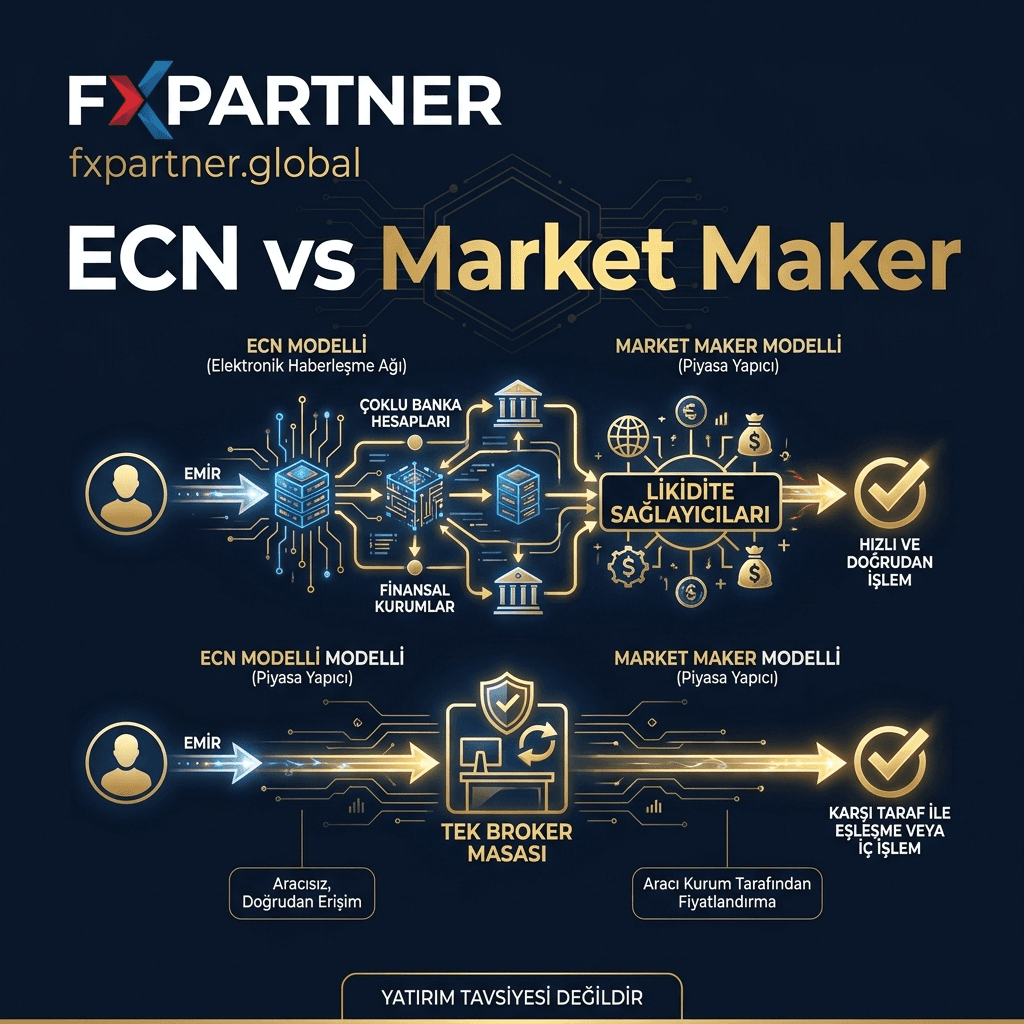
Market Maker brokers match client orders within their internal systems or act as the counterparty instead of routing them directly to the market. This model can offer fixed spreads and usually commission-free trading — providing an accessible structure for small accounts and beginners.
The criticized aspect of this model is that, theoretically, the broker is in a position to profit from client losses. With regulated, reputable brokers, this does not pose a problem — but it is important to know that pricing is based on the broker's internal pricing rather than raw market prices.
How does ECN/STP work?
ECN (Electronic Communication Network) and STP (Straight Through Processing) brokers route orders directly to a liquidity pool (banks, other investors). Prices are raw market prices, and the broker usually charges a fixed commission per lot instead of (or in addition to) a spread.
The advantage of this model is transparency — spreads can narrow or widen (floating spread), especially during high market activity, but the price reflects real market supply and demand. The disadvantage is that calculating total cost (spread + commission) requires slightly more attention compared to a Market Maker's "single fixed spread" pricing.
Which model is suitable for whom?
For investors starting with small accounts, seeking simplicity, and trading infrequently, the Market Maker's fixed spread + commission-free structure is generally more predictable. For active investors applying scalping or high-frequency strategies where raw spreads are more valuable than commissions, ECN/STP accounts are usually more cost-effective.
Many brokers now offer both models under different account types (for example, "Standard" and "Zero/Raw") — which requires asking the right question not as "which broker is better", but as "which account type suits my trading style". We cover this topic in more detail in our broker selection framework.
Best 5 brokers
 01
01XM Global
9.5IndexXM Global
- Min. deposit
- $5
- Leverage
- 1:1000*
 02
02Lite Finance
9.2IndexLite Finance
- Min. deposit
- $10
- Leverage
- 1:1000*
 03
03FxPro
9.1IndexFxPro
- Min. deposit
- $100
- Leverage
- 1:2000*
 04
04MultiBank Group
9.0IndexMultiBank Group
- Min. deposit
- $50
- Leverage
- 1:1000
 05
05AvaTrade
8.9IndexAvaTrade
- Min. deposit
- $100
- Leverage
- 1:400*
Sponsored links. Ranking is based on the FXPARTNER Index score, which consists of regulation, cost, platform, and withdrawal axes; affiliate revenue does not affect the ranking.